

Public travel plan
A Cultural Historian’s One-Day Palmyra Archaeological Expedition
Plan this as a dedicated, guided archaeological excursion rather than a casual stop: the journey involves roughly 3–4 hours of driving to Palmyra and about 4 hours back toward Damascus. A local tour company is specifica…

Source videos
Travel inspiration behind this plan
Plan notes
Useful context before you go
Plan this as a dedicated, guided archaeological excursion rather than a casual stop: the journey involves roughly 3–4 hours of driving to Palmyra and about 4 hours back toward Damascus. A local tour company is specifically presented as helping travelers explore Syria responsibly and safely; confirm current access, security conditions, permits, road status, and photography rules before departure. Bring sturdy walking shoes, sun protection, water, layers for changing desert weather, offline maps, and a camera. The site includes war-damaged and partially restored monuments, so treat damaged structures, military-sensitive areas, and local communities with respect.
Resources for this plan
Shared by the source creators. These are not VibePlanit endorsements and may be affiliate links.
Itinerary highlights
What is in this plan
Day 1 Palmyra Ruins and Desert Heritage
Leave early because the archaeological excursion follows a long desert drive. The sequence moves from the tomb complex to the oasis feature and then through the major monuments of the ancient city. Allow time to absorb the scale of the site, and keep the return journey in mind when planning the final visit.
-
Tomb of the Three BrothersTomb of the Three Brothers, Palmyra, Syria
Begin at the Tomb of the Three Brothers, a subterranean funerary monument with burial niches, surviving fragments of decorated ceilings, and remnants of statues. The tomb was also used as a bunker, so follow local guidance and do not enter restricted or unstable areas.
Watch the source moment on YouTube ↗ -
Ancient Well of PalmyraAncient Well, Palmyra Archaeological Site, Palmyra, Syria
Pause at the old well that helped sustain Palmyra as an oasis city in the middle of the desert. It provides essential context for why this settlement could flourish along the Silk Road.
Watch the source moment on YouTube ↗ -
Temple of BelTemple of Bel, Palmyra Archaeological Site, Palmyra, Syria
Explore the Temple of Bel, dedicated around AD 32 and described as one of the easternmost major complexes in the ancient city. Focus on the surviving entrance columns, altar area, massive outer walls, southern colonnade, and carved fragments among the rubble.
Watch the source moment on YouTube ↗ -
Monumental Arch of PalmyraMonumental Arch of Palmyra, Palmyra Archaeological Site, Palmyra, Syria
View the surviving and damaged remains of the Monumental Arch, the ornate gateway associated with the main colonnaded avenue. The arch was destroyed during the conflict, making the remaining urban layout especially important to interpret with a guide.
Watch the source moment on YouTube ↗ -
Via Recta of PalmyraVia Recta, Palmyra Archaeological Site, Palmyra, Syria
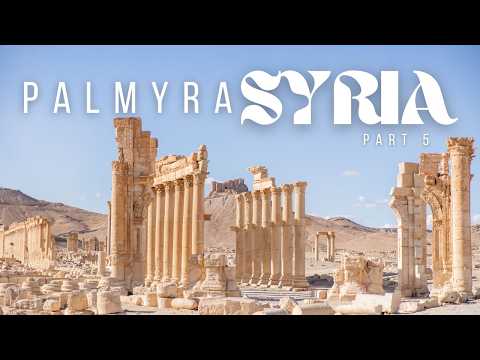
Walk the Via Recta, the principal colonnaded street running through the ancient city toward the hilltop citadel. The long perspective of columns and distant mountains is one of the defining visual experiences of Palmyra.
Watch the source moment on YouTube ↗ -
Roman Theatre of PalmyraRoman Theatre of Palmyra, Palmyra Archaeological Site, Palmyra, Syria
Enter the Roman theatre traditionally associated here with Queen Zenobia. Examine the stage-front columns and approximately 10–12 seating rows, then look back from the upper seating for views over the colonnaded streets.
Watch the source moment on YouTube ↗ -
Agora of PalmyraAgora, Palmyra Archaeological Site, Palmyra, Syria
Continue behind the theatre to the agora, the open marketplace connected with Palmyra’s Silk Road role. Use the broad plaza to imagine merchants exchanging goods between East Asia and the western reaches of the trading route.
Watch the source moment on YouTube ↗ -
Citadel of Fakhr-al-Din al-MaaniCitadel of Fakhr-al-Din al-Maani, Palmyra, Syria
Look toward the Citadel of Fakhr-al-Din al-Maani on the hill above Palmyra. Access may be unavailable while restoration and safety work continue, so treat this as an exterior viewpoint and do not attempt to climb to the castle without explicit local permission.
Watch the source moment on YouTube ↗